Building on a Wound: Behind Chapter 13 The Foundations of Fear


Teaser for Chapter 13
The Foundations of Fear is the hinge where the myth stops feeling ancient and starts stalking paperwork. We leave pure Shadow Realm surrealism and drop into 1896 Athens, West Virginia—blueprints, wages, mud, real men with real names—and let the Tear quietly rewrite the construction report.

Quick recap (light spoilers)
Autumn 1896. Concord State Normal School is being raised on Yula’mek: a “beacon of learning” planted where hunters and children already knew not to linger. Surveyor Elliot Byrne feels the wrongness first: trees leaning away, birds falling silent, the stone circle that will not be mapped. Then come the dreams. Then the woman. Then the deer. Then Elliott’s tent.
The state calls it superstition.
The land calls it payment.
By the final paragraph, the foundation for Room 316 is not just concrete. It’s consent.

Why this chapter matters
1. Horror comes home
Up to now, the Shadow Realm has felt cosmic, ritual-bound, myth-thick. Chapter 13 drags it into a date, a town, and a payroll. “Concord State Normal School” isn’t a nameless, cursed academy; it’s a place readers can Google. That tension—between the verifiable and the vile—is the whole engine.
This is the moment where readers think: Wait, how much of this is real? Good. That’s the point.
2. The institution is an accomplice
We’ve already met the monsters, the Lady, the Tear. Here we meet their favorite collaborator: infrastructure.
Blueprints aligned “with precision.”
An old stone circle bulldozed into a footnote.
Complaints filed and dismissed as “superstition.”
A school built exactly where it should never be.
It’s not just: “A haunted dorm exists.” It’s: The building is the ritual. The campus is complicity.
3. Elliot Byrne as sacrament
Elliot is the perfect victim and the perfect lens.
He’s:
Educated, observant, rational.
Sensitive to the land’s tension.
Mocked for being cautious.
Haunted until he’s… rewritten.
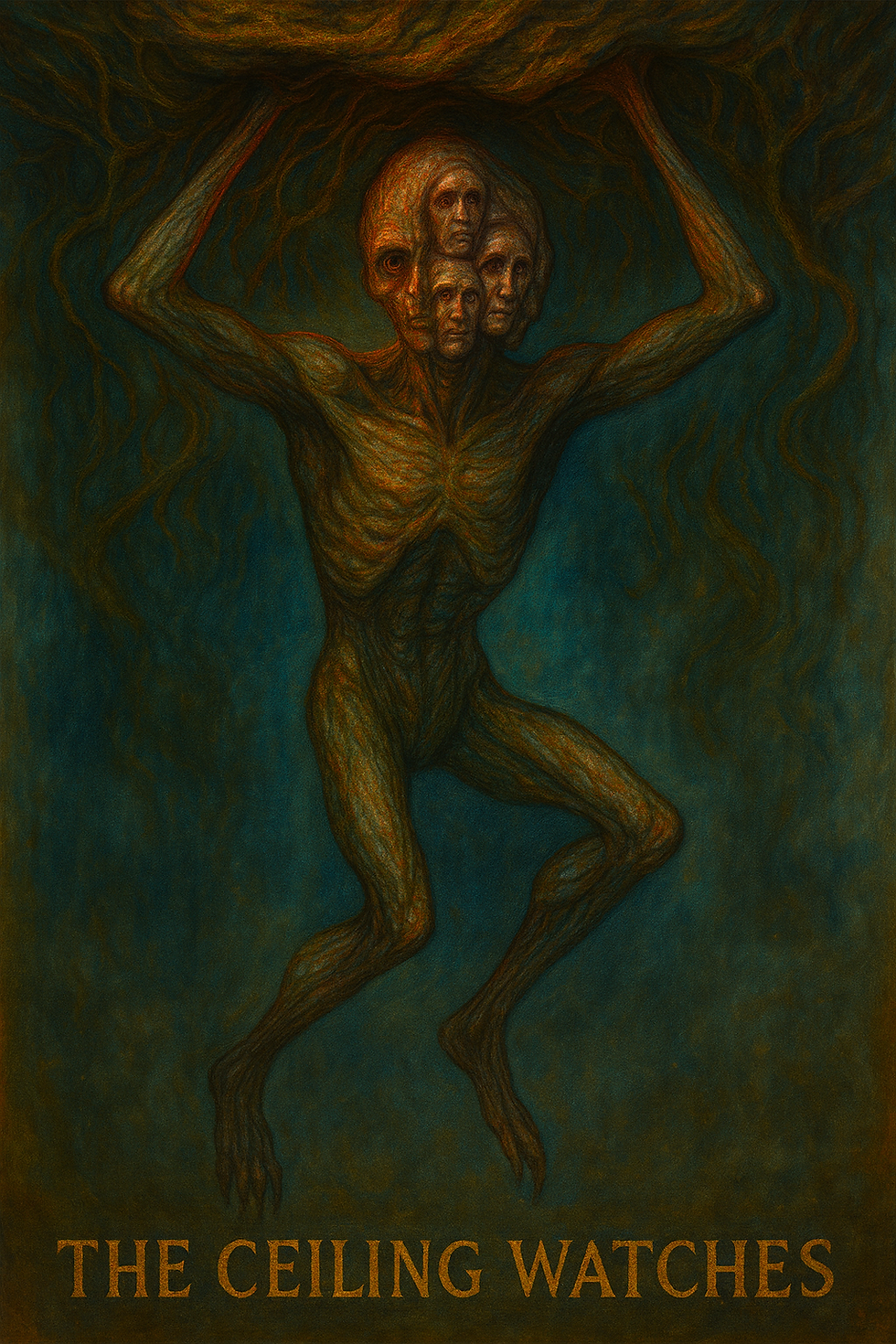
His death is brutal on the page, but structurally it does something colder: it turns him into a boundary marker. A human survey stake. The three vertical slashes on his forehead echo Wenonah’s visions; his teeth circle, his fused hands, his stolen tongue—all of it reads like the Tear signing its name at the jobsite.
This chapter says: we didn’t “discover” sacred ground; we buried the people who noticed.

History vs invention (and why it’s uncomfortable on purpose)
This chapter is built on a deliberate split:
Real bones:
The Concord location.
The broader Athens / WV setting.
The grim fact that early construction was dangerous and poorly recorded; people were maimed, crushed, buried in footnotes.
Invented flesh:
The specific cause of deaths.
The ritual precision of the site.
The Tear, the Lady, the curated hallucinations.
I didn’t fictionalize real victims for shock value. The rule I followed:
Treat real loss with respect. Let the horror be what crawls around the gaps in the archive, not at the expense of the dead.
So the story leans into:
How reports get softened.
How warnings get renamed.
How a cursed ridge becomes “Athens,” and “Athens” becomes a campus brochure.
It’s less “gotcha lore” and more moral indictment: it’s too easy to build your future on places that tried to tell you no.

Craft & intent
Tone shift: Coming off the Shadow Realm chapters, this one had to feel sober. Less fever-dream, more field report that rots in your hands.
So I:
Kept the language grounded: wagons, brass compass, ink, tents.
Let the surreal leak in slowly: symbols in margins, spinning needle, feathers in vomit.
Treated each escalation (the deer, the tent) like documented scenes, not hallucinations.
Imagery choices:
The deer is a thesis statement: natural order bent inward until it breaks.
Elliot’s altered body reads like a religious icon defaced. Prayer pose, marked forehead, grotesque smile: the Tear co-opts Christian funeral imagery and university respectability in one go.
Brick vs bone: every time you see “foundation” in this chapter, read “altar.”
Continuity threads:
Stone circle → old rituals → Wenonah’s altar → same wound, new veneer.
Dreams of halls and closets → early echo of Sarvey Hall and Room 316.
The gray-eyed woman → the Lady’s myth compressing into a new century.
Chapter 13 says: the haunt didn’t start with college girls. It started with the pour.

Question for the comments
When you hit Elliot’s fate and the deer in the trees, did this feel like a haunting creeping into history—or history being exposed as haunted? Where’s the line for you between exploitation and honest horror when fiction leans on real places?
Tell me in the comments. I’m listening.

Call to action
If The Foundations of Fear worked for you—if it made you side-eye campus buildings or think twice about where we pour concrete—share the blog, drop a quick comment, and send it to a friend who loves slow-burn, lore-dense horror.
And if you haven’t yet, grab The Lady in Flesh in print, eBook, or audio, and come stand on the ridge where the school was never meant to be.


Comments